
Giantz 320W Chainsaw Sharpener
1 review
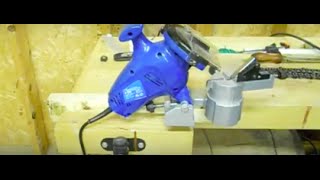

Excellent Low Cost Chainsaw Sharpener – I bought this chainsaw sharpener after the local mower/chainsaw dealer closed down - and he had been sharpening my chainsaw chains for $9 each, but more importantly, had been telling me when the chains were too damaged to resharpen. So I am no expert at this skill, but have spent countless hours looking at YouTube videos and reading articles on the internet. But with this Giantz sharpener, I discovered an advantage something no one mentioned in any of the countless articles I read or videos I watched, which will be discussed later.
The sharpener is a 320 watt unit, with 7500 rpm and comes with four grinding wheels of the same size, and is made of plastic. There are far more expensive metal units available, which YouTube videos mainly focus on. The video linked to below relates to a typical cheap unit, and while that unit doesn't look the same as the Giantz one, the method of operation is exactly the same.
How Much Metal To Remove From Teeth? What neither the instructions nor any of the videos or articles tell you, however, is exactly how much metal to take off the teeth when sharpening with an electric sharpener. This is a problem, as chainsawing is dangerous work.
With a manual sharpening kit, the articles and videos pretty much all say to apply three strokes with the file in its guide tool to each tooth - more if the tooth is damaged, and to apply that same number of strokes to all the teeth. Doing that doesn't really take much metal off each tooth.
How Often Can One Sharpen a Chain? Similarly, most articles and videos say that a chain should be sharpened only three times, or three to five times - which definitely doesn't take much metal off when done manually, but which can indeed take quite a bit of metal off using an electric sharpener. The articles and videos also all say that after one has taken quite a bit of metal off each tooth, one then has to file down the riser/depth gauge next to each tooth, else the chain won't cut properly.
After more research, I found videos of people saying they manually sharpened their chain three or four times a day when doing a lot of cutting (but said nothing about throwing them out), and others who sharpened their chain after using a US gallon (3.95 litres), and finally the chap in the following article who says you wouldn't throw away a kitchen knife after a few sharpenings, and explains how much a chain can be sharpened if nothing else is wrong with it. https://burlybeaver.com/chainsaw-chain-life-expectancy/
Disadvantage and Big Advantage. As the Giantz chainsaw sharpener is "cheap" and made of plastic, it also flexes a bit when pressure is applied to its handle when bringing the grinding wheel down to sharpen the tooth. This is a disadvantage, as it means that one can press further down past where one had set the stop mark on the downward cut, and thus cut into the link below the tooth - which can severely reduce the life of the chain, and possibly weaken it to the point of breaking when in use. This disadvantage would not happen with a more sturdy metal unit, and one needs to pay special attention not to be heavy handed when using the Giantz.
But this small amount of flexing also turns out to be a major advantage when one gets the knack. Instead of setting the grinding wheel to come down and cut off a small piece of the tooth as recommended, one can instead set the grinding wheel to come down and just miss the tooth - and then use the flexing to push the grinding wheel gently into the tooth with a light touch. This action probably takes off more of the tooth than manual filing does, but nowhere near as much as when setting a fixed cut as shown in most of the videos.
Results. To date, with the Giantz I've sharpened my three 14" 3.8LP 0.50 chains once, and I've sharpened three 22" .325 058 chains three times each - and I still haven't had to file down the risers/depth gauges on any of them, since I haven't taken enough tooth off (in case you are wondering why so much sharpening, the resharpened chains work like new when used for cutting my firewood, but then quickly get blunted as I try to cut up a big stump with lots dirt stuck between roots where I can't see it, which instantly dulls the teeth).
The unit comes with two holes in its base for putting bolts through to attach it to a work bench. I just drilled two small holes into my bench, then used two self tapping screws to fix the unit down tightly.
When using the unit it is important to wear safety glasses, and thin gloves are handy if one doesn't want to spend a lot of time with Solvol getting very fine grit out of one's fingers.
To sum up, now that I am aware of of the advantage and disadvantage of this unit, I am thoroughly delighted with the performance of the Giantz. I am quickly getting my chains to work like new, and I am not grinding off large amounts of chainsaw teeth to do it. Regards.
Extra Information
ProductReview.com.au has affiliate partnerships. These do not influence our content moderation policies in any way, though ProductReview.com.au may earn commissions for products/services purchased via affiliate links.