
Canon EOS R50
Verified4 reviews
- See all


We were recently in the market for a new digital camera. My wife is a coloured pencil artist who want's to get high quality reference photos of birds and wildlife for her art. Over the years, we've had a plethora of film cameras, digitals and bridge cameras that were good but not top quality. Even the excellent camera in the modern phone could not compare to a modern digital camera for picture quality. A friend loaned to us their Nikon P950 bridge camera to try out. It was a nice camera to use with pretty good picture quality but it had some minor limitations and lower picture quality than we really needed. When we were seriously looking at a new camera to buy for wildlife photography, it came down to a toss up between the Nikon P1100 bridge camera and the Canon EOS R50 mirrorless DSLR. After careful consideration, we chose the Canon. The choice was determined by two factors. #1. The Nikon had a smaller sensor with lower picture quality, has less low light capability, is heavy and was also not immediately available at any local stores and, #2. The Canon was cheaper, has a bigger sensor for better picture quality and is much, much lighter and we could have it right away. The Nikon has 16MP sensor and an impressive 125x optical zoom, equivalent to 24-3000mm and ease of use with no lens changes to worry about. However, the Nikon has a lot of glass and mechanical stuff in that lens casing and is heavy at 1.5kg. That's a lot of weight to carry all the time. The Canon on the other hand has 24MP sensor, it is much lighter than the Nikon. The body alone weighs only 380g and only 529g with the 18-45mm lens attached. It has a bigger APS-C sensor which is over 11x larger than the sensor in the P1100 and with much better low light capability than the Nikon. The Canon came as a 2 lens bundle with 18-45mm (152g) and 55-210mm (310g) lenses. For super long distance shots, I purchased an f11 600mm (940g) prime lens to go with it. Having the interchangeable lenses is a bit of a pfaff when you want to change focal length quickly but it also means that the camera is not heavy all the time. The EOS R50 with the 'huge' 600mm prime weighs 1.3kg vs 1.5kg for the Nikon. With the Canon, we need a carry bag with enough storage space for the camera body and the lenses. This makes the bag a bit bulky. The Nikon is much more compact and has a much smaller bag. I can't comment on the Nikon performance because we haven't used it, so I shan't; but after owning the Canon for a few months now, we have explored most of the many features and functions. Having owned a few "instamatic" and bridge cameras before, this one leaves the others in it's wake. It's by no means the 'Rolls Royce' of cameras, in fact it is a Canon 'entry level' camera. It is a mirrorless camera meaning that unlike an SLR camera, there's no mechanical gizmo to flip a mirror out of the way each time you press the shutter button. This makes it less complicated and lighter too with a longer life due to less mechanical gubbins' to wear out or go wrong. The view finder image is an LCD image from the sensor and not an optical path through the lens but it is still excellent. THE GOOD STUFF: This camera with all it's functions and quality is IMHO best bang-for-buck. It's perfect for a beginner or budget conscious person but with most of the features the more professional cameras have to offer rolled up in a compact package. It has some other nifty feature too, like the wireless connection to your phone or computer to download images. You can also control the camera hands-free from your phone. The image quality is very good and the lenses are easy to change. There is a viewfinder and a fully articulated 'touch screen' LCD display. There is a built-in flash and a 'hot foot' too. I have tried the time lapse function to video the summer storms rolling in and they look amazing. The camera has many cool functions to play with. You can leave it as a point-and-shoot camera set in "auto" mode, or fiddle around with ISO, F stop, shutter speeds and other settings to your heart's content to get the optimal shot. Being a newbie to the world of photography I am impressed with the abilities it gives me. Battery life is better than expected too. THE NOT-SO-GOOD STUFF: My only complaint about this camera is the button layout. All the buttons to change modes and do other functions are located on the right hand side (handle) of the body around where your right hand goes. This is convenient for operation but it means that they are susceptible to accidental pushing of the buttons just by holding the camera. It's just a minor 'first world' problem and something to get used to I guess. The EOS R50, like most DSLR cameras is susceptible to weather. There is no weather sealing so be careful to not get it wet. LENSES: Our camera came as a bundle with two lenses included. The lens hoods are not included but are available separately. The 18-45mm is perfect for family snaps, general photography and close-up's. The 55-210mm is best for sports and wildlife photography. The lenses are of the (12 contact) RF-S family and the RF mount is not compatible with the older (8 contact) EF lenses. However, there is an accessory adaptor ring available to allow EF lenses to be used on the RF mount. So, if you've got an old Canon, you can use the old lenses on the new camera but you need to purchase the adaptor. There is a wide variety of lenses from canon and other manufacturers like Sigma and Tamron available for this camera that can suite all needs. The EOS R50 camera body does not have image stabilisation. However, the RF-S (S for Stabilisation) lenses do carry that feature. CONCLUSION: I'm very pleased and impressed with our Canon. If you want a good all round but budget camera with all the bells and whistles, you can't go past the Canon EOS R50. It has all the tricks and trappings of expensive cameras at a fraction of the cost. It's light and compact and perfect for beginners and anyone wanting a good quality DSLR without spending a fortune.
Purchased in at JB Hi-Fi for $1,300.

The camera is fine, but trying to connect it to a phone or any other device is near impossible. Get ready to waste 8 hours trying, have everyone else try (unsuccessfully), use all the useless troubleshooting tips, and then reach out to canon only to be told you are not important now that they already have your money.
Purchased in .

Great camera for beginner YouTubers – I upgraded from the model this camera replaces, the discontinued M50, after a few years of trouble-free use. I liked that the R50 came with a few features that the M50 lacked, such as a USB C connection, uncropped 4K recording and the ability to connect straight to DC power without the need for a dummy battery. Used mostly for talking head videos and online meetings, the R50 is a great tool for me, as it's easy to use and set up and offers great video quality in a small form-factor. I have it mounted on my desk on a SmallRig post with Joby ball-mount and it sits neatly out of the way until needed. The R50 comes with a RFS 18-45mm F4.5-6.3 kit lens but I've swapped it out for a TT Artisan 17mm F1.4 for better low light performance. Autofocus is fast and accurate with the kit lens, outperforming the M50. One downside to this camera is the lack of Canon lens options and extremely limited range of third-party lenses. The screen is also harder to flip out than the M50 due to a change in the position of the finger cut-out from the side to top and bottom. Overall, this is a great, budget-friendly camera for beginners.
Purchased in at JB Hi-Fi for $950.
- +5

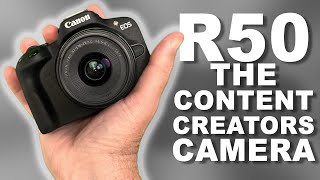
The Canon R50 IS THE BEST Creators Camera - here's WHY – The Canon R50 was released early this year as a replacement for the Canon M50. As you know the M50 was an amazing camera for creators at the time and had been updated with the Mark 2. The new R50 gives us features that we wished were in Canon M50 line. Let’s talk about things to love about the Canon R50 5 Things I like about the Canon R50 1. 24.2MP APSC CMOS sensor captures images in JPG and RAW. Remembering that this is Canon’s entry-level camera so the buffer when shooting RAW images will fill fast 2. This is the cheapest camera with the new R Mount - I picked up the limited edition twin lens kit with the 55-210mm Zoom and you can buy the EF to R adapter for EF and EF-S lenses, however you cannot use the EF-M lens options from the predecessor the Canon M50 3. Shoots 12fps mechanical shutter – 15fps with the electronic shutter and we now have Video has 4k 30fps with no crop. You have more settings available in NTSC mode with 11 options whereas in PAL this is reduced down to 6. Slow mo at 120fps is also available but there is no sound. There is no IBIS so stabilisation is provided digitally. If you’re shooting video this can help smooth out those bumps. There are 3 levels of stabilisation 0 - no stabilisation, 1-Light stability is applied, 2-enhanced stabilisation and 3-Auto level that tries to keep the horizon level when shooting 4. Light weight at 375g - just over 13oz and perfect for creators on the go 5. Improvements with autofocus - we now have eye tracking (people and animals) and vehicle tracking plus product mode is a great feature for creators to have as we no longer need to hide behind the product for focus. Max 651 zones for stills and max 527 for movies
Why choose the Canon R50 over your Smartphone 1. Background blur (bokeh) is natural and not processed like some smart phone shots you may have seen making it feel like a great step up from your smartphone 2. The fully articulating flip screen allows for shooting at various angles and seeing your subject easily when framing and it’s fully touch screen unlike other camera manufacturers 3. You learn more about photography when using a camera. How to frame, exposure for movement, aperture for depth of field and these skills transfer back to your smartphone photography 4. You will be able to get better low light or night time shots with better lenses 5. Sound capture with an external microphone. There are plenty of great microphones out there easily plugged straight into the Canon R50
5 Things I don’t like about the Canon R50 1. It’s not weather sealed so you’ll need to be careful when shooting in rain or dusty environments 2. The RF-S 18-45mm kit lens is not the fastest at ƒ/4.5–6.3 so it will struggle in low light. You may want to invest in a lens like the RF 16mm ƒ/2.8 or the RF 24mm ƒ/1.8 but these are getting pricey. The kit lens will get the job done if you’re not doing a heavy crop and after shooting for sometime you’ll know which lenses you’ll want to invest in 3. There is no IBIS so stabilisation is through cropping your video slightly 4. The hot shoe is now a multi-function shoe so you will need adapters for your non-canon speed light or triggers 5. Sound levels are not on screen when recording. You need to dive into the menus to adjust but it would be great if you can see quickly when recording that your sound levels are within usable parameters.
Summing it up If you’re looking to get into content creation on a budget then the R50 is a fabulous choice with the 24.2MP sensor, 4K no crop video, enhanced autofocus and interchangeable lenses. You will need to purchase additional batteries or look at a dummy battery solution or power over USB. 3rd party partially decided batteries are available for the R50
Purchased in at JB Hifi Home.
ProductReview.com.au has affiliate partnerships. These do not influence our content moderation policies in any way, though ProductReview.com.au may earn commissions for products/services purchased via affiliate links.