
Hobie Mirage Revolution 13
1 review
- +11


Minimalist fishing kayak that can handle some chop – The Hobie Mirage Revolution 13 is one of the older models in the Hobie fishing kayak range. The shape has generally remained the same; however, each model (generally released each year) has seen incremental improvements to the seat, mirage drive and/or other fine tuning to keep it relevant in the fishing kayak market. The 2018 model is reviewed here.
The Revolution 13 is relatively long at 4.09m (or 13.5 feet), is made from rotomolded polyethylene (plastic) and is generally marketed as the long range or open water fishing kayak from the Hobie fishing kayak range. It is a slender “sit on top” kayak with a sharp bow that slices through chop, unlike many other kayaks that tend to have either a flared or more bulbous bow - such kayaks have a tendency to bounce around in the chop and are much harder to drive through rougher conditions.
It is one of the narrower fishing kayaks on the market at 0.72m. Only the Hobie Mirage Revolution 16 is narrower at 0.70m. Most other brand fishing kayaks are usually in the vicinity of 0.86m or greater. Most fishing kayaks are going wider to increase lateral stability and to accommodate standing up while fishing. Being narrower means the Revolution 13 is not suited to stand up fishing; however, should such stability be required from the Revolution, Hobie does sell outriggers at an extra cost. Similarly, Hobie also sells a H-Bar which can be installed to assist in the standing position.
Don’t underestimate the stability of the kayak. Hobie quotes that its kayaks have secondary stability built into the hull design. This kayak is surprisingly stable, particular when the seat is set to its lowest position.
Being narrower, the Revolution 13 can move along quite quickly. Coupled with a Mirage Drive with Turbo Fins, the kayak can cruise comfortably between 5 to 6 knots. It can achieve 8+ knots if pushed harder. Being narrower and streamlined also means that this kayak can be comfortably paddled with the supplied paddle. The supplied paddle is two-piece and consists of a fibre-glass shaft and plastic blades. Its shape, although on first appearance looks on the smallish side, does have a surprisingly big bite in the water. This I attribute to its shape. Having the option of paddling instead of the pedal drive gives a good backup should the drive ever have any problems on the water or you simply want to do an upper body work out. Many of the other wider fishing kayaks are not conducive to paddling longer distances due to the need to reach out wide with the paddle.
The kayak is fitted with a removable fold out seat that is extremely comfortable. The seat has many adjustments to enable the user to find their most comfortable position while out on the water. The seat can be raised or lowered, the base can be tilted, the angle of the back rest can be adjusted and there is also an adjustable lumber support. The seat is well built with a breathable mesh material. The seat can also be removed and used off the kayak by extending some short legs that are included in the base of the seat.
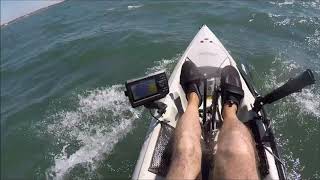
The Mirage Drive powers the kayak by using your legs. This frees your hands for fishing and other activities. One hand will, however, be required for the rudder control for steering the kayak. The rudder control is conveniently situated on the left hand side. Due to the sensitivity of the rudder, it is necessary to constantly control the rudder while in motion.
The Mirage Drive uses fins that move from side to side to thrust the kayak forward. It requires a pushing action using your legs while your feet are placed on the pedals. It is a pushing motion as compared to the many other pedal drives which use a bicycle motion to spin a propellor. I find the pushing motion preferable to a bicycle motion from a stability point of view. The circular motion of the many other pedal drives tends to generate a slight wobble. The comparison of the Mirage Drive to propellor drives has been a topic of many debates and forums, and will ultimately come down to what your preference is.
The Mirage Drive supplied with this particularly kayak is the MD180 V2 and has been upgraded with the Turbo Fins. The Turbo Fins are longer than the standard fins usually supplied with the kayak. Rule of thumb suggests that it provides approximately 20% more surface area on the fins, hence more thrust, albeit at slightly more effort.
This particular model drive has reverse, which is selected by pulling a tag/lever and another tag/lever to change to forward. Pulling the tag/lever effectively spins the blades 180 degrees allowing the pedals to work in the opposite direction. This is an effective system which is easy to use. Earlier models did not come with a reverse option and could only move in forward.
The Mirage Drive appears to be a complex drive with quite a few moving parts that are exposed. There is a tendency for the drive to squeak and clunk at times. It is not clear where the sounds are coming from and why, however, the drive seems to function normal. There has also been a tendency for one of the drive cables to come loose. These are tensioned by nylon locking nuts. I have added additional nuts to each to prevent them from loosening.
Whilst operating the kayak, you need to be aware of the water depth and of any debris/objects that may be present. Hitting the bottom and objects while in motion can bend or break the fins off. The Mirage Drive does allow the fins to lay flat against the bottom of the kayak, allowing the kayak to pass over obstacles, thus protecting them from damage. It is also possible to carry out shallow strokes with the drive if needed.
The Revolution 13 comes in a range of colours. Some of the colours change slightly from year to year and have generally been available as a range of single colours and not in the camo format that many other kayaks come in. My preference is the lighter colours as the darker plastic can heat up in hot conditions making it more prone to denting and sag.
As mentioned earlier, the kayak is rotomolded. It is a relatively thick plastic, which appears to be reasonably sturdy, when compared to some of the cheaper kayaks sold. The molding does appear to be a little rough at joins however, the strength of the kayak does not appear to be compromised.
What is important is to store the kayak properly. The instruction manual provided with the kayak stresses that the kayak be stored upside down as it is in its most rigid position. It is common to see many people store and transport the kayak long distances in the upright position. This will result in dents and/or deformation of the bottom of the kayak. The round cross-section of the Revolution’s bottom means that this will be a problem if not stored correctly. It is however, totally avoidable if stored and transported upside down.
Although a fishing kayak, the kayak only has two molded rod holders behind the seat. Any additional rod holders do need to be added at an extra cost. Many of the other fishing kayaks on the market, including some of the other Hobie kayaks, have additional rod holders, track rails and sacrificial plates designed to mount further rod holders, fish finders and other equipment. Space is limited on the Revolution 13; however, the lack of supplied tracks and other devices means that the kayak can be customised to your needs if desired.
The kayak is well set-out and the fixtures included are of good quality. All screws, bolts and bungees that go through the hull are sealed with a flexible sealant. However, there is a lot of burrs remaining under fixtures etc from when the kayak was manufactured.
The kayak is designed to accommodate a Lowrance fish finder transducer with a removable transducer plate being included in the bottom of the kayak. The plate is designed, and the cavity is sized, to take a Lowrance transducer. The hull contains fittings that allow the transducer and fish finder wiring to pass through the hull. The kayak comes with a range of fittings to suit various thickness wires - this ensures that a water tight seal can be achieved regardless of the wire thickness. Hobie calls these kayaks “Lowrance Ready” which suggests that there is a some sort of deal between Hobie and Lowrance. Although other fish finder brands can be installed, some transducers may not fit well and may require some modifications to fix in place.
Because this kayak is relatively narrow, it does not have as much storage space as some of its competitors or other wider Hobie models. It does have a relative large storage area in the bow with a size-able water tight hatch. This is a good area to store larger items. This area required a barrier to be placed within it to prevent items from sliding to inaccessible areas with the kayak - however, Hobie does sell a large bucket designed to fit in this area I have placed two foam pool noodles in this area instead as a cheap alternative this creating that barrier.
The kayak also has two smaller circular hatches, one in the centre and one in the rear. The centre hatch comes with a sealable tackle bucket. The rear does not have a bucket or other container, but does have a spare rudder pin in the hatch. The pin in the rudder is designed to be sacrificial should the rudder hit the bottom or other rigid object. The spare pin allows it to be repaired while out on the water - however, such a task could be challenging if in deep water, rough conditions or if there is no assistance available.
There are two side pockets which are extremely useful for storing fishing tools such as pliers, scissors, knife, or other items such as sunscreen, phone etc. The rear cargo area is also quite generous due to the length of the kayak and bungees are included to hold items there. There is a molded drink holder between the right hand side side pocket and seat. I have found this drink holder somewhat difficult due to its shallow depth - there is a tendency for the drink bottle to be knocked and it tipping out of the holder. This is a common occurrence while paddling and fishing.
The paddle is stored on the kayak on the right hand side of the kayak only. It fits into molded holders and the kayak lifting handle, and secured in place with a bungee. Although the paddle is stored well on the kayak, the paddle blade does catch waves at the front of the kayak when in choppy conditions.
The rudder can be lowered and raised by pulling two handles that connect to the rudder via cords that pass through inside the hull. There are handles on each side of the kayak just in front of the side pockets - one to lower the rudder and the other to raise it. These cords can be difficult, requiring considerable effort at times to lower and raise the rudder. There are times when the rudder needs to be lowered and raised several times to centre the rudder and remove a bias to one side of the kayak. It is not clear why this happens; however, several ups and downs can correct this.
The amount of options available for Hobie kayaks as well as the large range of after-market parts and additions is phenomenal. Modification possibilities are endless; however, are usually at a high price.
The Hobie Mirage Revolution 13 fishing kayak is a minimalist fishing kayak that is also a versatile and well performing paddle kayak. This kayak is designed for speed and can handle open and choppy waters. It will require additions and modifications for improved fishing capabilities and this will be at an added cost to an already hefty price for the kayak alone.
Extra Information
ProductReview.com.au has affiliate partnerships. These do not influence our content moderation policies in any way, though ProductReview.com.au may earn commissions for products/services purchased via affiliate links.