
Genesis GV60 Performance AWD (2022-2026)
Also referred to as: Genesis GV60 Performance AWD 2025 and Genesis GV60 Performance AWD 2027.1 review
- +8


One of the best luxury EVs you can buy...but highway efficiency could be improved – The GV60 is the introductory electric SUV from Genesis. It shares a platform with the Hyundai IONIQ 5 but adds a new body and a lot more features and performance to complement its higher asking price. I adored how the GV60 was put together. The only let down was the door handle, which can feel a little creaky at times. The materials and their assembly are all what you’d expect for a car that costs north of $100,000.
Although, I really didn’t like the hard white plastic that lined the rear boot, as it showed off lots of scuff marks and can make a lot of sound if items scrape along it when you’re driving.
This is the most expensive GV60 you can buy, as it’s the Performance AWD trim. It’ll set you back $110,700 before on-road costs and incentives.
You also get the choice of 5 years complimentary charging with Charge Fox EV chargers, or a free installation of an AC fast charger for your garage. I’d pick the AC charger.
The warranty is 5 years/unlimited kilometres, and 8 years/unlimited kilometres for high voltage parts. Service intervals are every 12 months or 20,000km, whichever comes first.
Servicing is complimentary for 5 years, and if you live within 70km of a Genesis Studio, your car will be picked up and a service loan car will be provided until your car is ready to be dropped back to you.
Just like the electric GV70 I tested, the GV60 is silent.
Active sound cancellation and lots of sound deadening keep the outside world where it should be: outside the cabin.
The audio system in here is supreme, and does a better than average job of filling the entire cabin with clear and crisp audio.
You can opt to produce some fake engine sound too if you want to maximise the feel of this futuristic interior.
Just like the electric GV70 I tested, the GV60 had a tendency to rock a little coming to a complete stop.
These brakes are beefy, but you’ll rarely be using them. Instead, you’ll more likely be using the regenerative braking system which can be adjusted via the paddles on the steering wheel. The one-pedal driving system offers you enough force to only require you to tap the brakes to ensure you stop in time for a set of traffic lights.
You’re getting a maximum of 360kW (482hp) and 700Nm. This power is reserved for Boost mode, which is activated for 10 seconds at a time via the large ‘Boost’ button on the steering wheel.
Eco, Comfort, and Sport modes will cap the output of this car to slightly less than what is possible. But you’ll simply need to press that Boost button to turn this thing into a drag racing machine.
Going from 0 to 100km/h takes just 4.0 seconds, and you’ll need to ask your passengers to place their heads on the headrests to avoid any neck strain.
The presentation of the crystal rotary shift dial adds to the cabin look and feel. It has a great weight to it as you twist the car into gear.
A single forward gear is used in the GV70, and it’s an intoxicating feeling to simply sail at a range of speeds without interruption from any gears.
There’s a set of lights that project from the rear of the car onto the ground when you shift into reverse. It’s a nice touch to get a quick visual sense of how close the car is to certain objects.
It’s a rapid car, but the higher seating position disconnects you from the driving experience, unlike the Kia EV6. It’s more of a powerful grand tourer that has more than enough power for overtakes and spirited moments of driving.
It has decent handling characteristics, but at the end of the day, the weight of the battery pack is felt through some tight corners and when braking.
The biggest benefit when buying this EV is its battery pack. It’s a 77.4kWh battery that runs on a 800V battery architecture system, the same tech you’ll find in something like a Porsche Taycan. It’s a more efficient battery, making it quicker to charge and slower to discharge.
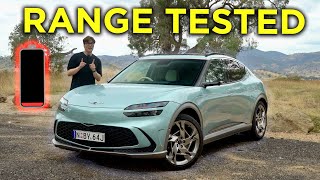
The claimed range is 445km (WLTP), with a real world range closer to 400km, as indicated by the vehicle itself.
Charging can take as little as 18 minutes when charging from 10 to 80% from a 350kW charger. There aren’t many of those, so if you encounter a 50kW DC charger instead, it’ll take you just over an hour to recharge to that same amount.
The claimed consumption is just 18.8kWh per 100km. I saw figures as low as 16kWh per 100km in city driving, but out on the highway I averaged 20-21kWh per 100km.
Using a fast charger was great with this EV out on the road, but be warned: a full charge from a 100kWh+ fast charger costs around $40. Maybe that Charge Fox subscription might not be the worst idea.
I can claim that the range is fairly accurate, but to maximise it you have to turn off the air conditioning. That made for a sweaty trip to the charger to ensure we had just enough to make it there. We maximised the range and arrived with just 3% (11km) of range left.
Instead of a glass roof, I would love to see solar panels as an option across all Genesis cars, like the ones you find on the G80 Electrified, just to get a little extra range.
Rumour is that a bigger and better battery pack is on the way, which is already being used in MY23 and MY24 IONIQ 5s.
The interior is simply breathtaking. It offers a blend of traditional luxury with some splashes of sci-fi-like technology.
The crystal ball in the centre console flips over to reveal itself as the gear shifter. There are two very large 12.3-inch displays and two monitors near the mirrors for the digital side mirrors.
I had some complaints about that digital side mirror viewfinder, as some passengers claimed it made them a little more prone to being carsick.
The white leather interior was a standout feature, but might be a bit of a pain to keep clean. There are also some clever storage solutions underneath the centre console and under the climate display, and there’s even a pull out glove box.
There’s 432L of boot space: 1460L with the second row folded and an extra 20L for charging cables underneath the bonnet.
I found a few backpacks dominated the boot space back here, so it might prove to be a little cramped for a small SUV. There's some extra space under the boot floor for smaller items, but there is no spare tyre.
Want the ultimate combination of luxury and performance? The GV60 offers some of the best bang for your buck in this luxury EV space. It can’t be overlooked if you’re shopping upmarket against brands like Mercedes-Benz.
Don’t need all the luxury or conveniences of a Genesis? Just get a Hyundai IONIQ 5 or even a Kia EV6. They all share the same battery tech, and have mostly the same features.
*Disclaimer - I work for ProductReview as their independent car and motorbike expert. I borrow new cars and motorbikes from manufacturers and owners to review. I am not paid or incentivised by these brands to post reviews. I write and create content to provide insight and information about any new or used vehicle I can get my hands on.
Extra Information
ProductReview.com.au has affiliate partnerships. These do not influence our content moderation policies in any way, though ProductReview.com.au may earn commissions for products/services purchased via affiliate links.