
Kia Sorento MQ4 AWD PHEV GT-Line (2022-2026)
VerifiedAlso referred to as: Kia Sorento MQ4 AWD PHEV GT-Line 2025 and Kia Sorento MQ4 AWD PHEV GT-Line 2027.1 review
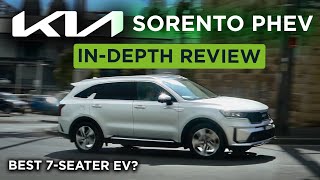
- +8


Expensive but a strong PHEV 7-seat SUV family car option – Kia’s build quality is better than ever. It’s solid, there’s a conscious elimination of that ‘tin’ sound in the doors, and there’s never a squeak or rattle out of place. Some scratchy hard plastics exist on the interior. However they’re part of an element that’s there for utility rather than luxury. Buying this trim of the Sorento does not necessarily bring any additional ‘build quality’ to the already impressive Sorento GT-Line.
However, adding extra weight via the form of a battery pack provides an illusion that the car is heavier on the road. Heavier cars are usually perceived as more luxurious, and this is a tactic used by brands like Bentley and Mercedes Benz. It works here for that same effect, even if you’re driving around in a Kia.
Is it worth spending $15,000 more for a $79,330 (before on roads) Sorento that’s able to reduce fuel consumption and run as a pure EV?
The answer depends on your needs and wants for your next family SUV. If you want to reduce your fuel consumption, CO2 output and have the ability to drive partly as a pure EV - this is certainly the best option out at the moment for a 7-seater PHEV.
The Sorento PHEV isn’t cheap, but as far as electric vehicles that are this big go, it’s a lot cheaper than the competition. Tesla Model X and Volvo XC90 Recharge are the only other 7-seater SUVs able to run as pure-EVs. Sure, the Model X is only an EV, but the point still stands.
If you don’t care about any of the above, then don’t waste your time, and just jump into the diesel powered Sorento GT-Line.
Two drivetrains prove to be a little more expensive than GT-Line diesel over 7 years of servicing. Kia has reduced the number of kilometres between each service, resulting in coverage for only 70,000km (or 7 years) vs the diesel’s 105,000km (same period).
Your total cost of servicing over 7 years comes to $4,903 compared to the diesel’s $3,463 total cost of servicing over 7 years.
I couldn’t help but notice the same brakes used on the Sorento PHEV felt a little more stressed than the ones on the diesel.
There’s just over 100kg in additional weight added to the Sorento PHEV compared to the diesel. Brakes are easy to modulate for a smooth operation, but the harder you push when traffic suddenly stops in front of you, the more you can’t avoid feeling there’s additional mass onboard.
The Sorento PHEV scores a petrol 1.6L turbocharged four cylinder unit producing 132kW at 5,500rpm and 265Nm at 1,500 - 4,500rpm. It’s paired with a permanent magnet synchronous electric motor, producing 67kW at 2,100 - 3,300rpm and a whopping 304Nm at 0 - 2,000rpm.
Total output delivered through the AWD system is 195kW and 350Nm. This is a unique set-up, as the electric motor provides a hefty punch. This produces more torque than the petrol motor, and more kilowatts than the diesel engine.
The bulk of the torque delivered at 0 rpm is noticeable, and allows the Sorento to hustle off the line a lot quicker than its diesel counterpart. It’s silent and quick to react to acceleration. However, you can’t win against physics in a car this big. Speed begins to fall and you can feel the Sorento ‘run out of puff’ once that petrol motor kicks in.
I thought the way the petrol engine remained accelerating, despite me lifting off the accelerator for an additional second, was a terrible characteristic of this motor. It’s something that I hope Kia can eliminate from future Sorento PHEVs.
That electric motor is great for low-speed acceleration, but it’s no substitute for performance. It’s not going to be a budget Porsche Cayenne E-Hybrid unfortunately.
Surprisingly, you lose the brilliant 8-speed gearbox for the more expensive PHEV model, and instead receive a 6-speed automatic. Nonetheless, it still does a great job of managing revs in a car like this.
Shifts never really missed a beat, although this gearbox occasionally missed opportunities to shift into a low enough gear to take full advantage of that low-down torque.
The Sorento is more than capable through corners, where it never faulted thanks to the batteries being lower down in the car's body. It only enhances the cornering ability of this Kia.
The bottom line is that it’s extremely comfortable.
1.6L per 100km was as low as I could get for the total consumption for the Sorento, and reached as high as 4.6L per 100km when the battery was depleted.
You can get up to just under 50km of real world range with the pure EV mode in the Sorento, and rely on the petrol motor to run this car as a hybrid when you run low on electrons.
The battery pack on board is a 14kWh battery, so it’s not enormous. That means if you want to charge from home, you can charge the battery from 15% to 95% in 3 hours and 25 mins using a fast charger.
But, at least with a plug-in hybrid, you don’t have to rely on plugging in the car to charge up the battery. The onboard charger can charge the battery with speeds of up to 3.3kW, so it's more like a trickle charger rather than something that can charge over just a few minutes of driving.
You do lose boot space and interior comfort to the battery pack located under the rear seats.
Boot space is down to 175L with all the seats up, 604L with the third row folded away and 1988L with all the seats folded flat. It’s now got less than 2000L of total space compared to the diesel’s interior boot space.
The only real incentive to buy this car in Australia is to either reduce your carbon footprint or to reduce your fuel bill. That means justifying paying $15,000 more than the diesel upfront to own and drive a car that still pollutes, but at a significantly lower rate. If you have a place to charge most nights, you can run on pure electricity for most of your daily commute.
*Disclaimer - I work for ProductReview as their independent car and motorbike expert. I borrow new cars and motorbikes from manufacturers and owners to review. I am not paid or incentivised by these brands to post reviews. I write and create content to provide insight and information about any new or used vehicle I can get my hands on.
ProductReview.com.au has affiliate partnerships. These do not influence our content moderation policies in any way, though ProductReview.com.au may earn commissions for products/services purchased via affiliate links.