
Land Rover Defender 110 3.0L Petrol MHEV P400
Verified1 review
- +8


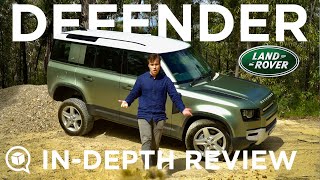
Land Rover's best 4X4 – The new Defender has moved away from its traditional body-on-frame design, the usual suspect off-road design of choice. Now utilising an all-new aluminium body, which is designed to provide increased rigidity and safety. The Land Rover Defender P400 SE starts from $102,736 (before on-roads). This isn’t exactly the bargain of the century, especially if you add on the options that saw our test vehicle priced at $116,116 (before on-roads) - That’s until you compare it to its competition like the Toyota Land Cruiser Sahara, Lexus LX or even the Mercedes G Wagon.
To summarise, after placing the price of the new Defender into perspective, it certainly does represent value for money for its performance both off and on road, space, safety features, and the overall fit and finish.
This Defender you see pictured was fitted with a $6,500 satin polyurethane wrap, which plays a very important role when cleaning and maintaining your Defender. This wrap not only provides the matte finish to the Pangea green metallic paint, but it also possesses self-healing properties.
This car had off-road tires fitted, and during my week I hardly noticed them apart from the occasional roar of these tires making their presence known under sharper turns.
The speaker system in the Defender was certainly a highlight, as this vehicle was fitted with a Meridian sound system. The depth, clarity and fidelity of the sound emanating from these speakers is close to class-leading.
On-road, the Defender inspires confidence, despite weighing in at over 2 tonnes. You’ll be able to stop both smoothly and in an emergency thanks to four large disc brakes and the addition of autonomous emergency braking. Off-road, the Defender is able to come to a stop and hold on slippery surfaces, and on sharp descents that feature limited to no grip.
When you opt for a Defender fitted with the P400 motor, these are the headlines: 294kW, 550Nm and a 0-100km/h time of just 6.1 seconds. Powered by an all-new turbocharged petrol inline-six mild-hybrid motor, the P400 trim possesses what Land Rover refers to as its Ingenium motor, and it could not be further from what previously powered the old Defenders.
On-road, you can have an absolute blast on some back roads when you settle the car into its lower suspension setting. Shift the car into the sport setting, and lay into that accelerator pedal, and you’ll certainly have yourself a performance SUV. The way this Defender sprints up to speed is quite entertaining because you’ll feel as if you’re maneuvering a small studio apartment’s worth of space around the road. Off-road, the mild-hybrid system really shows itself off, it provides the necessary low-down power that traditional diesel motors offer by comparison. It allows for a further spread of torque. From 2,000rpm through to 5,000rpm, you’ll receive all 550Nm to help you out of those stickier spots. If you really crave that torque to be available lower than 2,000rpm, you’ll need to opt for the diesel engine options. From 1,400rpm to 4,000rpm, you’ll receive all 440Nm.
Over the evolution of these gearboxes, Land Rover has certainly learnt and improved, which leads us to this 8-speed automatic. I was brought to a sort-of zen moment when I began to drive the Defender and experience this gearbox. Finally- Land Rover has a gearbox that blends a higher number of gears without feeling too busy and is far more responsive than gearboxes of the past. This is the case whether it’s changing manually using the sequential shifter pattern, relying on the car to downshift to the right gear at the right time, or revving out the inline-six to redline in sport-mode. There is one main downside; the responsiveness from throttle input being translated into vehicle movement. I’m not sure if this is a manufactured lag, or something that is specific to Land Rovers but every Land Rover I’ve driven, even Range Rovers, have had this lag.
If you like air-suspension, you’ve come to the right place. This is key to the new Defender’s ability to transform from the school runner into a formidable off-roader. There are three settings for your air suspension on the P400 SE, these include: Access Height: This is the Defender’s lowest setting, which can be locked, allowing you to enter underground car parks or multi-story complexes. This reduces the Defender’s height by 20mm to 1950mm of total height. Normal Height: This is the Defender’s standard setting, and is used for all on-road applications and high speed driving scenarios. The Defender’s standard height is 1970mm. Off-road Height: This is the Defender’s highest and most impressive setting. It enables the Defender to utilise its 900mm wading depth and overall class-leading combined approach, ramp-over and departure angles. Off-road 1 setting will raise the Defender to 2020mm in total height, off-road 2 setting will raise the Defender to 2045mm in total height.
What took me by surprise was the amount of fuel you can consume when driving around congested inner-city streets. I was fully prepared to see an increase in fuel efficiency from this mild-hybrid system, but was ultimately a little disappointed in this category. On the highway, great, you see the mild-hybrid system working as it should. Revs drop to as low at 1,100rpm, while driving at speeds of up to 110km/h, returning an average consumption figure of 10L/100km. This is pretty much on target with Land Rover’s claimed 9.9L/100km figure for this P400 engine. It was day-to-day driving in the city, egged on by a few strong moments of acceleration, where this consumption figure soared. On average, over 5 days of driving, I saw figures as high as 20L/100km as an average for daily driving.
To summarise this interior: it is rugged yet plush, full of tech, has plenty of space, and most importantly, it’s safe (thanks to integrated blind spot monitoring lights in every door).
With all seats in their usual positions, you have a total of 972L of usable space! That’s enough to take four people’s worth of luggage and carry those individuals too. The rear seats fold in a 40:20:40 split, allowing you to pass through longer items, like skis or a couple of surfboards, between two rear occupants. If it’s just yourself or the two of you, you can have up to 2277L of cargo space loaded onto a relatively flat floor, without any awkward drops or lips to maneuver around. Helping with ingress and egress of items, you can lower and raise the air suspension from the rear, to allow you to customise the entry height of the rear cargo space depending on your needs.
Contextualise the price, and yes, you absolutely should. When in the market for a luxury SUV that has proper off-roading capabilities that will even impress those who spend every weekend knee deep in the mud, you’re looking at prices starting at $150,000 and above.
Sure, you can source capable, comfortable off-roaders as low as $70,000, however, we can’t kid ourselves that these are of equal status to the likes of a Defender, G-Class or the revised Lexus LX. Capability, yes. Status, interior features and power, not really.
The Defender really does represent decent value, for not only being a great go-anywhere vehicle, but also making you feel special, with unique features and luxury appeal. *Disclaimer - I work for ProductReview as their independent car and motorbike expert. I borrow new cars and motorbikes from manufacturers and owners to review. I am not paid or incentivised by these brands to post reviews. I write and create content to provide insight and information about any new or used vehicle I can get my hands on.
ProductReview.com.au has affiliate partnerships. These do not influence our content moderation policies in any way, though ProductReview.com.au may earn commissions for products/services purchased via affiliate links.