
Land Rover Discovery 5 S SD6 (2016-2026)
VerifiedAlso referred to as: Land Rover Discovery 5 S SD6 2025 and Land Rover Discovery 5 S SD6 2027.1 review
- +7


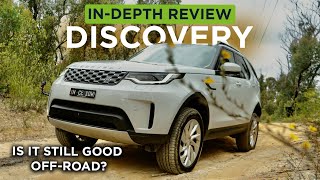
The family hauler with serious off-road capabilities. Thoughts from a Discovery 3 owner of 10 years – Build quality is an absolute strong suit for the British manufacturer in recent years. Even though this is the Discovery S (the entry level model), construction was at its highest throughout the cabin and on the exterior. Weighty doors, solid ‘thunks’, high quality faux leather and cloth seats and soft touch plastics were a treat. This is the Discovery S D300, meaning it packs the best diesel engine option Land Rover offers. Priced from $101,875 before on roads as a starting point, throw in a few options like the ‘Advanced Off-road Capability Pack’, wireless charging, and an ‘Active Rear Locking Differential’ and you’re looking at a $110,910 car.
From memory, our fully-laden Land Rover Discovery 3 HSE TDV6 was priced around this point, so a combination of inflation and price rising has occurred since 2006 - that’s for sure.
To be honest, there’s a lot of standard equipment provided on the new Discovery, even in its base form.
Air-suspension, comprehensive 3D camera system and electronically folding seats are all excellent standard features that usually would have been reserved for higher trims.
Land Rover recently upped its warranty offering from 3 years to 5 years/Unlimited kilometres with 5 years of roadside assistance. You can purchase a service plan for 5 years or up to 130,000 kilometres of driving, for $2,650.
Wind noise was non-existent - something I’d put down to the dramatically smooth design, compared to previous generations of the Discovery.
Stopping a Land Rover never felt so smooth. I distinctly remember the car I learnt to drive on (the Land Rover Discovery 3) was incredibly smooth to operate, and was more than capable at sudden braking and trail braking away from danger.
The same can be said here, but with additional ability than a car built in 2006. Braking is predictable, and requires no more effort than using a brake pedal found in a Fiat 500.
Under the bonnet of this Discovery is a 3.0L twin-turbo charged 6-cylinder diesel mild-hybrid motor, and it packs a real punch.
Traditionally, big cars and big diesel motors never result in performance on the road. However, Land Rover’s Ingenium D300 motor is a completely different story.
Producing 220kW at 4,000rpm and 650Nm at 1,500-2,500rpm, there’s plenty of power here being sent to all four wheels via an AWD system. 0-100km/h times are as brisk as 6.8 seconds, which is quicker than my 1000kg Abarth 500! This is mum’s 7-seater SUV we’re talking about, which is faster than ever.
The 8-speed transmission in the Discovery was mostly fault-free, although on occasion it did have a moment where gears clunked together, rather than being swiftly engaged.
Around 95% of my driving saw a flawless performance from the Discovery. Shifting into gear was easily operated, I especially love the dedicated park button that helps you avoid any mis-shifts.
5% of the time I experienced moments of indecisiveness from the gearbox, which momentarily distracted from an otherwise premium driving experience.
Land Rover’s air suspension system is a lot of fun, thanks to just how adjustable it is. The car can move from an access height, through to ‘Off-Road 2’, which allows it to wade through 900mm of water.
The ride height difference is amusing at times, allowing you to tower over Mercedes G Wagons, and then change the height to enter a sub-2m tall underground car park.
It’s a sublime ride, and there’s never an issue with being uncomfortable in the Discovery. It’s capable on road, through corners and on loose surfaces. Although, compared to the Defender, I could tell the Discovery did waver a little bit through sweeping bends at high speeds, thanks to its high centre of gravity and narrower footprint.
Off-road, there’s a reason why you’ll see more smiles in a Discovery at the end of a serious trip away from the tarmac, compared to cars like a Jeep Wrangler. Ruts, rocks and large dips in the road didn’t once make me feel uneasy, unlike some cheaper 4x4 SUVs. It’s clear that spending the additional money provides a far superior ride both on and off-road.
Even though this is a diesel, has turbochargers and is a mild-hybrid, don’t expect to be saving at the pump. Claimed combined fuel efficiency is 7.5L/100km, however daily driving saw me produce figures as high as 12L/100km, even after heading out on the highway.
Land Rover has stepped up the game with the new Discovery’s interior. It’s an exercise in minimalist design, while still giving you everything you need right at your fingertips.
There’s plenty of space throughout the cabin, however it starts to get a bit cramped in the third row’s foot well. I particularly love just how much foot room the driver gets, making it a lot more comfortable to drive long distances behind the wheel.
The curved infotainment display uplifts this cabin into 2022, along with a noticeable lack of physical buttons. The important ones are there, like climate controls, volume and terrain response, but that’s it. I miss the old adage that you could operate all the features in a Land Rover while wearing a pair of thick gloves.
As Land Rover becomes more reliant on screens, you’re going to need to ditch the gloves to take full advantage of that touch screen.
Storage is the other headlining feature here, with a ridiculously deep, dual level glovebox and secret compartments under the transmission tunnel and behind the climate controls. It was a lot of fun to see just how much stuff you could fit in and around the Land Rover’s interior.
With all three rows up, there's only 258L of boot space on tap. However, fold all of those seats down, you’ll reveal 2391L of boot space. You’d see why we chose this car back in 2006 to help us move to Australia after living overseas.
A most welcomed surprise was just how easy it was to operate the electronically folding second row seats. Both up and down, you can use buttons in the boot to completely fold the second row flat, making it less of an effort than ever before. Although, if you want to just fold the middle seat down, you'll still need to do that manually.
Second row space is extremely generous, although the seats sit a little too close to the floor of the car, creating a gap between your knees and the seat itself. This forces you to recline back to retain comfort on long trips. Seating for three is beyond reasonable, as three adults can place their feet comfortably on the flat floor, thanks to an absence of an obvious exhaust/transmission tunnel.
Despite its size, third row seats are a little tight for adults to comfortably rest. Additionally, the ingress and egress hasn’t been as well executed like in cars such as the Kia Sorento. However, if you frequent the third row, it’s still one of the larger sets you can sit in, this side of $150,000.
The only reason my family didn’t keep our old Discovery for longer than 10 years was the cost of servicing post-warranty. When things go wrong (and they did), it did cost a lot to keep a car as complex as that on the road.
We weren’t burnt by our experience, rather, we bought a Range Rover Evoque to ‘downsize’ from the burly Discovery 3. Additionally, I think we would step into a new Discovery if we wanted to, as it really is an excellent evolution forwards for the iconic nameplate.
The added warranty period gives a massive leap in confidence for what would usually be a normal finance period (5 years). Although, my eyebrows would become raised following the end of that warranty period, from our past experiences.
For most, the Discovery will hit the nail on the head for a car that’s easy to use deep in the inner-city, and take out into the wilderness. By comparison, the Defender can become a little too big for its boots when operating along the school drop-off route and in tight side street parking situations.
*Disclaimer - I work for ProductReview as their independent car and motorbike expert. I borrow new cars and motorbikes from manufacturers and owners to review. I am not paid or incentivised by these brands to post reviews. I write and create content to provide insight and information about any new or used vehicle I can get my hands on.
ProductReview.com.au has affiliate partnerships. These do not influence our content moderation policies in any way, though ProductReview.com.au may earn commissions for products/services purchased via affiliate links.