
Hyundai i30 PD Sedan N (2018-2026)
VerifiedAlso referred to as: Hyundai i30 PD Sedan N 2025 and Hyundai i30 PD Sedan N 2027.2 reviews
- See all


- +8

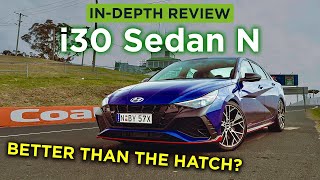
Possibly the best value performance car you can buy – The build quality is relatively premium for the asking price. It’s obvious Hyundai have built this on what is essentially an economy car, so doors and surrounding plastics do feel like they’re a little on the cheaper side. However, Hyundai has splashed some nicer feeling leather seats, premium stitching and high-end screens, raising the perception of quality inside the cabin.
Here’s why I have both transmissions to review here: it’s because both the manual and automatic i30N Sedan start at $49,000 before on-road costs.
For over 200kW and a sedan body style, it’s hard to find cars comparable to this. It’s not a hot hatch, but it is front-wheel drive only.
Regardless, it’s a respectable asking price for the caliber of car you’re purchasing.
Covered by Hyundai’s standard 5 year/unlimited kilometre warranty alongside a track day warranty, the i30 Sedan N is hard to say no to.
Services are at 10,000km apart (or every 12 months) and are capped at $335 a visit for the first 5 visits.
Don’t let the plush materials fool you that this is a quiet luxury car; this is very much a stripped down performance sedan.
The speakers do the job well, making calls and audio easy to understand at most speeds. Pick up the pace, and road noise from these larger and stickier tyres become very apparent in the cabin.
There are some fake engine sounds to choose from, but I’m not entirely sure why you’d want tot use these.
They play via the internal speakers. I can only assume that they’re there to prepare us for the inevitable EV transition the N Performance team is going to have to make.
Of course, this wouldn’t be a Hyundai N car without a neighborhood-disturbing exhaust note. It’s baritone, accompanied by a hint of intake and turbo whoosh. Releasing the accelerator from your lead foot leads to a hellfire of overrun pops and crackles - the loudest I’ve heard on any of the N cars I’ve tested.
By the way, the DCT produced more audible and more consistent pops and bangs compared to the manual
I especially appreciated the additional size and stability of the chassis of the sedan when it came to braking.
Trail braking into corners was a lot more predictable, and I never managed to cook the brakes to the point where they obviously softened.
These brakes were developed in-house by Hyundai, and despite the fact that they’re not even cross-drilled, they hold up against hours of relentless backroad driving. That’s thanks to additional cooling and the fact they’re 55mm larger than the ones found on the i30 Sedan N-Line.
In the DCT, the i30 Sedan N will also allow you to left foot brake and use the accelerator at the same time.
If you’re deadset on buying the fastest N car Hyundai has to offer, you need to buy the DCT over the manual.
This is for two crucial reasons. One, both cars get 206kW of power at 5500 to 6000rpm and torque is rated at 392Nm between 2100 and 4700rpm. The DCT gets an overboost feature that momentarily provides more power for 20 seconds via the ‘N Grin Shift’ button on the steering wheel.
Two, the DCT is capable of hitting 100km/h in a mere 5.3 seconds, while the manual will be left hanging at 5.8 seconds to 100km/h.
Open your eyes a little and try driving the DCT, and you’ll see why I consistently prefer it as my transmission of choice in Hyundai’s N cars.
It’s been relentlessly engineered for maximum driver engagement, with smart features that can adapt the transmission to how you're driving too.
Each click of the paddles offer a shove in the back, similar to an aggressively tuned single-clutch. Launch control is more fun in the automatic too. And when you’re not interested in shifting your own gears, it makes for a relaxing gearbox in bumper-to-bumper traffic.
It’s rare I’d pick the automatic when the manual seems like the obvious choice, but it’s possibly the best DCT that isn’t made by Porsche.
Open your eyes a little and try driving the DCT, and you’ll see why I consistently prefer it as my transmission of choice in Hyundai’s N cars.
It’s been relentlessly engineered for maximum driver engagement, with smart features that can adapt the transmission to how you're driving too.
Each click of the paddles offer a shove in the back, similar to an aggressively tuned single-clutch. Launch control is more fun in the automatic too. And when you’re not interested in shifting your own gears, it makes for a relaxing gearbox in bumper-to-bumper traffic.
It’s rare I’d pick the automatic when the manual seems like the obvious choice, but it’s possibly the best DCT that isn’t made by Porsche.
Depending on how you drive, you might get close to the claimed 8.2L per 100km (combined) consumption figure. But you’re more likely to get closer to 10L per 100km in the city, or 15L if you love the sound of that loud exhaust.
There aren’t any major changes to the design of the already striking i30 Sedan interior, but there are notable N Performance improvements.
That includes new bucket seats, an N Performance steering wheel, blue stitching, new pedals and an N Performance sub menu on the screens.
I would have liked to see the option to have the more aggressive lightweight bucket seats - like those in the i30N hatch - for more visual theatre, but there’s a more subtle performance theme here.
There’s around 464L of boot space available in the back of the i30 Sedan N. It’s limited compared to the hatch, thanks to that Sedan boot shape.
Additionally, it’s limited because of that rear stiffness bar, limiting you from loading in long and large items.
Don’t forget that the rear seats fold as one bench, and not as a 60/40 split. That means you’ll have to make the most of that boot space if you want to carry passengers too.
The back seat also loses rear vents and rear seat heating or rear USB ports, making it feel like a stripped out race car.
If hot hatches aren’t your thing, and the Kona N isn’t ticking any boxes for you, look to the i30 Sedan N.
The i20N is for lightweight traditional hot hatch fun. The i30N hatch ups the ante and is a graduation in power from the i20N. The Kona N is the hot hatch for those who don’t want to drive around in a traditional hot hatch.
The i30 Sedan N takes the characteristics of a sedan (a long and planted wheel base) and mixes that with the potency of Hyundai’s formidable 2.0L turbocharged unit to form a road car inspired by a TCR touring car.
It feels more stable at high speeds compared to the hatch, and has a slightly more grown up feel to it - apart from the fact there’s a massive wing hanging off the rear.
Get the DCT for the performance factor, but get the manual if you can’t be convinced otherwise. It’s an engaging drive that offers plenty of driving thrill - a rare sight in today's car market. It feels like a bit of a last hurrah before cars like this turn electric.
*Disclaimer - I work for ProductReview as their independent car and motorbike expert. I borrow new cars and motorbikes from manufacturers and owners to review. I am not paid or incentivised by these brands to post reviews. I write and create content to provide insight and information about any new or used vehicle I can get my hands on.

Luxury car – Hyundai i30 premium n Beautiful interior Drives amazing Luxury car Husband uses to and from work. Bought brand new from dealer, last in Australia currently apparently. Didn’t come with any extras though like mats or dashcam.
Purchased in at Hyundai Dealers for $51,000.
- Bought: New
ProductReview.com.au has affiliate partnerships. These do not influence our content moderation policies in any way, though ProductReview.com.au may earn commissions for products/services purchased via affiliate links.