
- See all


- +8

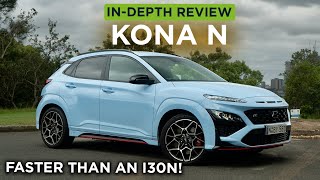
The best small performance SUV for the money – The Hyundai Kona has proven itself to be a well-built little SUV. The doors have a satisfying weight and sound and most of the interior trim is squeak and rattle-free. Stitching around the suede leather seats, shifter and steering wheel isn’t out of place at all. I especially loved how Hyundai took the time to cover up any screw holes that you’d be able to feel but not see if they hadn’t been on the steering wheel itself.
That doesn’t mean there weren’t a few questionable elements - like the way the centre screen squeaked if you moved it ever so slightly, of how the rear diffuser around the exhaust flexed a little too much for my liking when cleaning it.
Starting from $47,500 for the base Kona N or $50,500 for the ‘Premium’ trim before on-road costs, it’s hard to argue against the fact this SUV is a performance bargain.
I was driving around in the Kona N Premium, which meant that I had nicer seats that were both heated and cooled, a heads up display, a sunroof and a heated steering wheel.
You definitely don’t need this upgrade, but it did live up to making the Kona N feel a little more ‘premium’.
There are no direct competitors to this small, front-wheel drive, performance-oriented SUV. You can head closer to $100,000 and you’ll find cars like the Audi SQ2 and Mercedes GLA 35 AMG, however those are a lot more expensive, and they’re all-wheel drive.
Part of that affordability sentiment is the fact this comes with not only a 5 year/unlimited kilometre warranty, but also with a track day warranty for the same period.
It encourages you to not just enjoy the Kona N on the street, but also to use every ounce of engineering behind what makes the Kona N so great to drive, out on the track.
Over these 5 years, you also receive capped price servicing fees, resulting in an average cost per service equating to around $284.
Noise isolation is a bit of an issue in Hyundai’s N Performance cars because you have stickier tyres and a booming engine and exhaust tone.
Not even an upgraded Harman/Kardon sound system could completely block the sound that bled into the cabin. You’re going to hear more road noise thanks to those bigger and grippier tires.
Podcasts and music were more than enjoyable to listen to through these speakers, however I found myself far more interested in that exhaust sound.
Like many other reviewers, I’m in disbelief at just how Hyundai managed to get this exhaust tune passed by Australian regulators. It is beyond loud when you open those valves and start to lift off that throttle or go for some aggressive down shifts.
These brakes are a whole 55mm larger than the ones you’d find on the standard Kona.
You can guarantee they are effective, seeing as the increase in brake size isn’t because the Kona increased in weight.
Extra stopping power is recommended when you have the most powerful motor in the Kona line up. If you can hit 100km/h in 5.4 seconds, you need to stop just as quick.
I find it liberating that a motor like this is available to purchase at this price point, rather than having to spend major cash for a properly developed engine.
This isn’t just a slightly tuned 2.0L turbocharged petrol four-cylinder powerplant; instead, it’s been fettled by Hyundai’s N Performance division to provide proper performance.
There’s a wide powerband for both peak power and peak torque. 206kW arrives as soon as 5,500rpm through to 6,000rpm and 392Nm from as little as 2,100rpm through to 4,700pm.
For an engine paired to a large turbocharger, that wide torque band and high end power translates to a strong acceleration and the ability to use all of your revs.
Some engines like this hit peak power early in the rev range, meaning that riding out to redline isn’t as productive as shifting a little earlier - not exactly the best driving experience. What’s fun is that Kona N allows you to ride to redline and enjoy power through to the end. It’s a far more sophisticated turbocharged engine experience, and all for a reasonable asking price.
Since this is a dual-clutch automatic, launch control can be activated and simply engaged by pressing the brake pedal and mashing the throttle. Lifting off the brake doesn’t result in an unruly scramble for grip by the front tyres. Rather, the car accesses that peak torque early, and proceeds to throw you to 100km/h quicker than the i30N hatchback can.
Not to mention that this car has an overboost feature called ‘N Grin Shift’. Via a button labeled ‘NGS’ on the steering wheel, you can increase peak power to 213kW for 20 seconds to either get that extra speed out of a corner, or go for that overtake. It requires a 40 second cooldown between runs.
This would be the biggest differentiation for those looking to shop between an i30N hatchback and a Kona N.
The additional ride height and increased tyre wall size means the Kona offers a far softer ride than the i30N across all surfaces.
It becomes the hot hatch for passengers who hate riding around in a hot hatch. Thanks to adjustable dampers, you can have the Kona N ride just like a normal SUV for the most part.
I averaged around 10L per 100km over 1000km of driving, only seeing figures as low as 8L per 100km during long, uninterrupted highway drives.
The Kona is a whole 50mm shorter than the i30N, meaning you have less boot space than the lower-riding hatchback.
There’s 361L available with all the seats up, and 1143L with all the seats folded down. It’s an easy-to-live-with boot space, as the load floor is flat all the way through and the seats are easy to fold.
It’s a lifted hot hatch for a reasonable price. It’ll be the sensible choice if you’re regularly carrying passengers who don’t love the idea of an aggressive hot hatch like the i30N.
For that reason alone, of being able to have your cake and eat it, I’d recommend you buy the Kona N if you’re constantly in a debate with others about whether you should be in a hot hatch.
*Disclaimer - I work for ProductReview as their independent car and motorbike expert. I borrow new cars and motorbikes from manufacturers and owners to review. I am not paid or incentivised by these brands to post reviews. I write and create content to provide insight and information about any new or used vehicle I can get my hands on.

So much fun – Brings a smile everytime I hop in it. Good fuel economy if you baby it. Back seat room is small so suits only occasional use.
Purchased in for $55,000.
- Bought: New

Brilliant – Cant be more positive about the driving experience coming from Golf r and choosing the Kona N Premium in preference. Cupra guys never bothered to contact after numerous try's but I'm glad. Was concerned not all wheel drive but not an issue....it's just manic and too much fun!
Purchased in for $57,500.
- Bought: New

Incomparable – After a year of searching for a powerful and affordable car, the Kona won me over. It has a 4-cylinder engine, which means cheap registration fees and good fuel economy. The scheduled maintenance is also affordable at $350 per year, and the insurance is very reasonable. The Kona comes with a 5-year warranty that includes track use, as well as complimentary roadside assistance. The premium trim level is packed with technology, including all the bells and whistles you could possibly want. And best of all, the engine is amazing. It's powerful enough for everyday use, but it's also gentle on the gas. I couldn't find anything similar at this price point from other brands, such as Volkswagen, CUPRA, Ford, Kia, or Audi
Purchased in at Hyundai Dealers for $58,000.
- Bought: New
ProductReview.com.au has affiliate partnerships. These do not influence our content moderation policies in any way, though ProductReview.com.au may earn commissions for products/services purchased via affiliate links.