Best Sanders

Festool ROTEX RO Series
Perfect addition to existing my Festool sanding gear – I already have the Rotex RO150 but the RO90 is perfect for those tight spots and live edge sanding. The Delta pad is also very handy on this machine.… Read more
The addition of the RO90 brings my tally of Festool sanders to 4 and I couldn't be happier........they all have their strong suits in different applications. Quality gear.

Festool RTSC 400
Perfection! – I have several Festool tools and this sheet sander is definitely one of my favourites! Once you use a Festool - nothing else compares.

Makita MT Series M9400G
Value for Money Old School Power tool – I'd previously bought a Ryobi belt sander which turned out to be disappointing junk (see my other review). After going through 3 of those I decided… Read more
to go with the Makita M9400 after reading some of the reviews here and what a difference. The Ryobi felt like a toy compared to the Makita. This is your old school power tool with no fancy gimmicks, just one speed (with a lock) and a large cloth collection bag for the dust. Its very powerful and best of all has a 100mm wide belt which makes sense if you're sanding 90mm wide deck boards like I am, meaning less back and forth required and reduced risk of not sanding flat like you would with a 75mm wide belt. The tension knob also keeps the belt tracking straight with minimal adjustment. The first thing you notice taking it out of the box is how heavy it is due to the metal body. This is both a good and bad thing, as the weight of the machine does all the sanding work, but you'll be using muscles you forgot you had to reign this beast back in. So far I've sanded more boards with this machine than the three Ryobi's combined and its still going strong, doesn't get hot and has only used 2 sanding belts (Ryobi I used about 10 because of its bad tracking). Although I paid a little bit extra, this machine is definitely value for money. I think that Bunnings doesn't stock this item (only the far more expensive Makita 9924 version, at twice the price) as sales of the Ryobi's would stop, so I had to source it from Total Tools instead but it was worth it.

Bosch Random Orbit Sander
- See all


Orbital sander PEX 400 AE - dust box fail – Huge dust box issues. Falls off easily. Nothing really holding it on. Heatlh hazzard. Plus, very hard to open it to remove dust, and then hard to… Read more
close it again. Major fail and for that reason, as it is a health hazzard, I do not recommend you buy it despite the sander working fine.

Festool DTS 400
Love this little sander – I love this thing, it’s so compact and the dust extraction from the CDIMidi is exceptional. I’m going to get the orbital 125mm for my bigger projects Show details
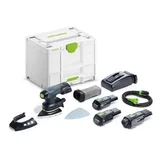
Festool DTSC 400 Cordless
DTSC 400 is compact, lightweight and very easy to handle, making it ideal for sanding tight corners, and hard - to - reach areas. Cordless design is a big advantage, feels comfortable to use.

I've used orbital sanders from plenty of different brands, but Festool is still the best. Honestly, there's just no comparison.

Makita 9924DB
As good as they get – After my Previous Makita belt sander had a hernia after some 25-30 years I purchased the Makita 9924DB. As they say its a beast. Bit on the heavy side but so powerful . This is one good belt sander Show details

Ozito Orbital Sander PXROS-125
Solid unit – I've used this orbital mostly for plaster sanding, and considering amount of plaster dust it's had on it I'm surprised it's still going strong. The… Read more
velcro is good and it has plenty of power for harder tasks. It is a funny shape to hang on to but you get used to it.

Festool ETS 150
I finally coughed up for a Festool after another $100 brand name machine died. I've been resisting for years. It was worth it - the performance just… Read more
in terms of material removal and finish, along with dust extraction, was light years ahead of anything else I've used. One tip, get the 5mm one, not the 3mm one, unless you only want a fine finish sander.

Festool LHS 2 225 Planex
I have just purchase the LHS 2 225 Planex (24.3.2025) with an additional extension arm, after long consideration on whether to spend that amount of… Read more
money or not & I'm glad I did, it takes your sanding to the next level. I'm working in a fully functional supermarket, (ceiling plaster repairs & a complete paint job), it is easy to use & set up, extremely quiet, allowing you to still talk to people while the machine is operating, from the littlest of sanding jobs, that cover you in white dust & leave mess ever where, this machine is effortless & clean, to a big open, pre-painted ceiling that you thought looked okay from the ground, well put this machine over it & you won't believe the difference it makes, it will seriously take your finishes to the next level, with no mess, when you're finished for the day, you're finished, no need for any other cleaning up, it's all in the machine, happy sanding.

Makita BO5041KX
Average performance, expensive, terrible warranty – Bought this sander in late 2018. At 2.5 years old the motor burnt out after moderate use (timber work only). This sander was almost double the price… Read more
of any others available, yet it has the shortest warranty of them all (including those 1/4 of the price). I purchased a replacement sander for $75, which I found is more powerful and generally feels better, plus has a 4 year warranty! I see ZERO reason to purchase this Makita sander over any of the competitors, it's worse in every way.

The rap – The tools amazing got three other sanders great reputable tools But this girl just leaves them for dead The price is indicative of the work they… Read more
can achieve Eg. $200 sander needs $1000 worth of labour to achieve the same result as the $1000 sander with $200 worth of labour And my SISTER really can tell the difference between them!!! Enough said

Bosch Belt Sander
DIY Sander – This is a pretty good sander, aimed at DIY use. It only costs around $155, which is pretty good for a belt sander for smallish jobs and/or occasional… Read more
use. It is probably unfair to compare with a bigger, more powerful sander, aimed at tradie, professional use.
I have used it for plenty of big and small jobs and it works well. Just make sure you have the right grit sandpaper for the job, and let the sander do the work. Don't push down too hard and if you see the paper sliding off to one side just back off the pressure a little. Be a little patient and it will get the job done well. Beware pushing down or applying too much pressure, you can take off too much very quickly.
One thing I really like is that the top has 2 screw holes. Screw a board onto the top, tip it over, clamp the board to your bench and you have a small linisher. I use it in this position to sharpen mower blades, old chisels, knives etc. Does an awesome job.
It hooks up to my shopvac, and very little dust is released into the air. Much better than the dust collector it comes with. Belts are readily available, and reasonably priced, especially on Ebay.
Great for DIY usage. If you plan on using regularly, invest in a Bosch Blue, or similar.
Would buy another, it has never let me down.

Ryobi EBS800 / EBS800V Belt
Great design and plenty of power – The adjustable platform under the belt stoops the digging in that has screwed up other belt sanding jobs. Light, even pressure and consistent speed… Read more
across the workpiece makes roughing so easy. Unfortunately there is a design error with the placement of the dust collector (which does work!) In that, it's proximity to your hand while using it can give you some nasty static shocks. It would be better if the port for the dust collector was round to accept a vacuum, instead of rectangular. Plenty of grunt and variable speed helps for different features of my project. Belts didn't slip off, all ran true on my machine. Changing belts was annoying due to the adjustable frame but benefits outweighed the negatives, especially when working with exotic timber where digging in is not really an option. Requires all ppe, including hearing.

Ryobi 370W Belt & Disc RBDS4601G
- Price (RRP) $185
- See all


I have a workshop full of Ryobi gear. The 370w grinder sander is crap. Grinder unbalanced, sander breaks belts constantly. Impossible to adjust belt balance with adjustment screw unwinding constantly. Worst machine I have

Festool Planex LHS 225 E
Planex Easy – As a proud owner of 10+ Festool tools and 7 years of using Planex just had a chance to use an Easy version. Wasn't really that easy. This piece of… Read more
engineering should NOT have a Festool badge on it. It is a real disaster! Miles and miles away from a standard Planex in speed, weight and comfort of sanding. Any cheap chinese alternative beats it by very far. Couldn't believe that Festool tool can be that poorly performing. Must admit that it is quite silent compare to other brands

Makita BO4556K
Good sander – Good sander, have had others that weren't as good. Can be easily used with sandpaper rolls and stays on secure. Does create a fair amount of dust even with the bag.

Ozito Portable Drywall Sander PDS-2000
Great tool for DIY – If you are a DIY person having a go at plasterboarding thennsanding is the worst job but this tool makes the job quicker and easier with considerably… Read more
less dust. I gave it 5 stars, not because it is the best tool on the market but because it does well what it is designed to do and does so at a reasonable price.
Some tips if you are new to power Sanders on drywall; - use the finer included 260 sandpaper if you top coat is smooth, which it should be. The finer paper is less aggressive so you are less likely to sand back to the tape - less is more - don't press too hard, let the machine do the work, keep a enough pressure to keep it level to the surface. You can always go back and do a little more - some say do a pass on the outside then a pass on the middle, this is what I did and it worked well. - use the trigger lock, this means you can concentrate on positioning and holding the tool and that it will continue to run after you lift it off the wall, which is important for the dust extraction. - if you practice on some waste board first then do that because you need to get a feel the tool creating a suction on the board, this is what enables the vacuum of the dust. - the included sand discs are enough for 1-2 rooms
I used it on a cathedral ceiling which was tricky to learn on but made the job much easier so well worth the purchase.

Makita MT Series M9204G
Good value for money - really happy with it – This sander is light & easy to use, gives a good finish and the dust collection works better expected. Haven't had any issues with pads coming off… Read more
yet although still relatively new
It isn't that aggressive and for rough surfaces I still use a Makita belt sander initially. However this little sander is excellent for tidying up the marks left after the belt sander or by itself if the wood wasn't too bad to begin with.
Dust collection is better than the belt sander.

Makita DBO180Z
Light and easy to use but not perfect – We bought this to replace a corded (and ancient) Bosch RO sander that while still working had all the drawbacks of a corded tool. It has 3 speed… Read more
settings (7, 9.5 &11k OPM) and a 2.8mm orbit action. In use, I really miss the 'D' handle of the Bosch becasue this really doesn't have anywhere to get a good grip on it and that makes it a little hard for precision work or odd shapes (like wooden arms on a chair for example) where it's difficult to guide. However, it's got plenty of power and does a great job of bulk sanding work in areas where something like my half sheet sander isn't a good fit. The 'fit' of the dust collector isn't great and you get a bit of dust from around the joint and in our market the cloth reusable dust bag option isn't available (although you can get it out of the UK like I have).

Bosch PSS 250 AE
So far so good; it did the boat – Does a good job and seems robust. You can buy either the pre-punched sandpaper that is affixed by velcro or you can clip in the sheet having cut it… Read more
from a normal-sized sheet of sandpaper. If you can't find the template and punch to make the holes in the sandpaper, just use a screwdriver. It's easy,

Makita BO3710X
A huge improvement over the previous one – I bought a Makita Orbital Sander about 35 years ago; when I finished the job, I took it outside, and smashed it with a sledge hammer. It was a most… Read more
frustrating tool, and that simply because paper would waltz off the sander as soon as it was put on. I prefolded paper, did all I could, and all to no avail. When I needed another sander, I looked around and found that (a) Makita had changed the paper clamp, and (b) no other sander had any better method of clamping - so, I took a chance on Makita again - and I’m glad I did. These clamps work! As BakerSam said, there are no frills with this, but that’s fine with me. Dust extractor is better than nothing, but not great, but then the previous one had none at all. All in all, a good budget sander.

Ozito Belt Sander BSR-7000
3 Year Warranty – Fortunately this Ozito Belt Sander BSR-7000 comes with a 3 year warranty as after 2 sanding belts worth of course sanding, the 'Belt Tensioning… Read more
Lever' failed. Upon returning to Bunnings I received a new replacement. I based my purchase on the type and amount of my timber projects. Plus I had remaining 75x533mm sanding belts at home.
While this product is basic, e.g. no variable speed setting I did not require all the bells and whistles of operation. Belt Fitting was required on the first Ozito, yet the replacement Ozito sander it was not required as it ran beautifully. Cleaning is a must during and after usage... Best not to over heat this tool...
My initial thoughts were to purchase the (5* rated) Makita 9924DB, however upon feeling the weight I changed my mind.
[+] 3 Year Warranty Light weight Carbon Brushes are easy to DIY
[-] Belt fitting can be exasperating! Belt Tensioning Level is incredibly harder to shift in comparison to other belt sanders I've used.

XU1 810W Corded Belt Sander
Awesome, so easy to use and so powerful. This belt sander will drag you around the floor. We did our kitchen floor with it, two thumbs up from me. Well worth the price you pay for it.
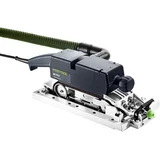
Festool BS 75mm Belt Sander
A True beast – I've got the rotex and ets 150 sanders and this bad boy is my go to for panels and boards straight out of the thicknesser. The frame is brilliant for even sanding across long and wide panels. Watch out for the systainer though, its huge!!!

Fantastic Linisher – 1.56HP has plenty of grunt. Invaluable when working metal and belts are relatively inexpensive. Belts are a challenge to change as the guiding is… Read more
extensive. Can be used with or without the tool rest depending on what you are use to. No good for internal radius work due to guarding. A different machine required. Can be used for wood and metal. Good extraction and very stable base. Have not had to bolt down. Quality build. Bought from Machinery House for approximately $1000.

Makita BO4900V
A great sander – Dial up electronic variable speed control. Hook and loop with large lever clamp paper fastening system. 330W Motor provides 10,000opm. Half sheet… Read more
sanders obviously save time when working on larger areas and this one is both light, easy to use and has well dampened vibrations meaning that it can be used single handed when needed.
Purchased in 2019, it has since done moderately heavy work including sanding two large decks plus numerous smaller jobs around the house and has performed flawlessly. The variable speed control is handy to have and you can also lock the trigger on so you don't have to hold it all the time.
For the overall size, it's lightweight and powerful and a big step up from the previous Bosch orbital sander.

Bosch Multi Sander
- See all


**DO NOT PURCHASE THIS ** Utter RUBBISH product. Have not even turned this UTTER RUBBISH unit ON! The black part "should" be attached to the red… Read more
part.. attempted to pull off the sandpaper and the whole thing peeled off. Utter rubbish and poor product. I AM STILL WAITING AFTER 3 WEEKS for replacement or refund but the company is STALLING in their replies. DO NOT PURCHASE ANY BOSCH PRODUCT. need to change their name to BOTCHED! Bill G

Don't Buy – I've purchased 2 & both died with a pop & flames. Both worked fine doing small areas however they were both underused & died very quickly. I'm lucky… Read more
that my fingers weren't over the top vent where the flames came out. Very dangerous product. Only buying BOSCH from now on.
Types of sanders
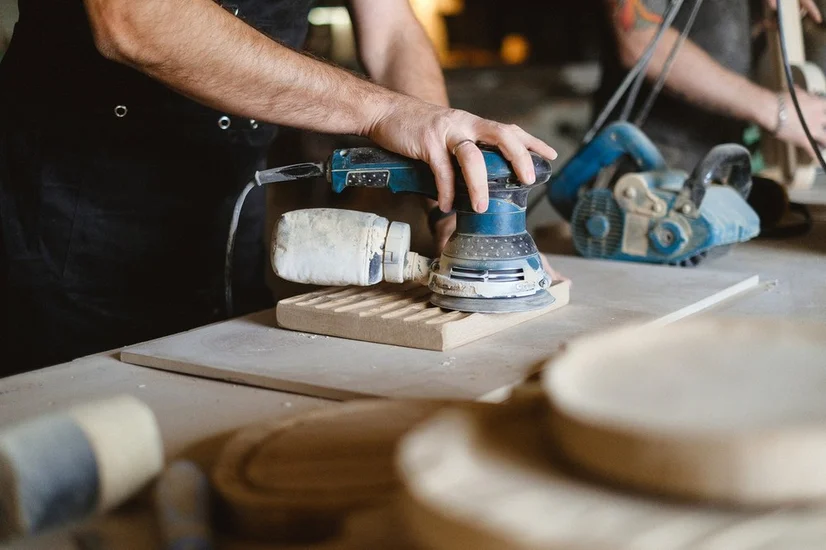
A sander is a power tool that’s used to smooth surfaces by abrasion with sandpaper. It can be used for a variety of purposes, including removing paint, upcycling pieces, and smoothing the surface and applying finishing touches to a range of materials.
Power sanders have helped us do away with the tedious chore of manually scrubbing away at a plank of wood with a piece of sandpaper. They can help you complete a sanding job that would have taken hours by hand in minutes - however sanding by hand is still a crucial part of many jobs today.
Here’s a list of some commonly used sanders.
Manual sanders
A manual sander, or hand sander, is the least expensive sanding tool you can buy. They’re easy to use, and as the name suggests, require manual labour to operate and achieve a smooth, even finish.
They’re suitable for small projects where the wood is already in good shape or has already been sanded - you can then come in with the manual sander for touch-ups.
Even if you’re thinking of buying a power sander, a manual sander can be a good tool to have around to complement your electric sanding.
Orbital sanders
An orbital sander has a rotating base (called a platen) that moves circularly or orbitally. They’re used for general jobs, and are a great option to remove fine layers of material, such as paint or varnish.
They’re easily used on both plaster and timber.
Suitable sandpaper: An orbital sander takes standard sandpaper sheets, hook-and-loop sanding pads or special self-adhesive sanding pads.
Detail sanders
A detail sander is a triangular orbital sander. It’s a great option for sanding furniture, corners, and other hard to reach places.
Random orbital sanders
A random orbital sander has a round, vibrating sanding pad that also spins in a circle - it’s probably the most common power sander in Australian tool sheds.
It’s particularly useful for achieving a fine finish, and can be a suitable option if you’re planning on staining or painting the finished product.
Suitable sandpaper: A random orbital sander suits round self-adhesive or hook-and-loop sanding pads.
Belt sanders
A belt sander has two drums over which a sand belt moves around quickly. They’re great for sanding large, flat surfaces, such as floorboards, and are most commonly used to remove large amounts of material quickly.
To avoid damaging your working surface, use a belt sander with the grain of the wood. Also ensure you’re applying adequate pressure to the tool as it may “run away” from you if you don’t.
Suitable sandpaper: A belt sander requires cloth sanding belts - ensure you get them in the correct size for your sander.
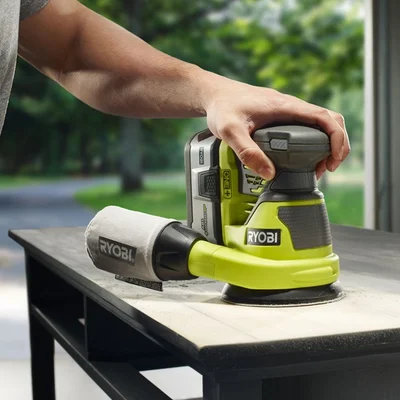 A random orbital sander. Image credit: Ryobi. | 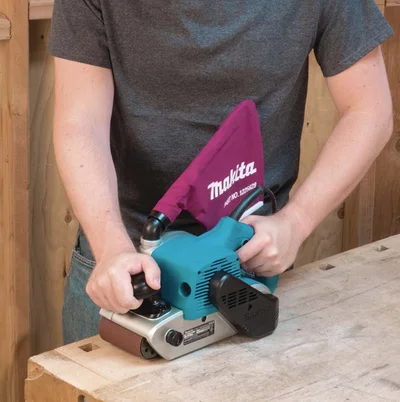 A belt sander. Image credit: Makita. |
Other types of sanders
There are also specialty sanders on the market that may be more suitable if you have more specific jobs or require some detailed work to be done.
- Sander polishers: A sander polisher can both sand and polish the piece you’re working on - they’re usually best for sanding timber and for polishing painted surfaces. You can also usually polish with some a random orbital sander.
- Drum sanders: A drum sander spins a sandpaper tube around a motorised drum. They’re useful for sanding curved surfaces and large surfaces such as floors. Some come in smaller sizes, like drill bit sanders or those designed for rotary tools.
- Belt-disc sanders: A belt-and-disc sander is a belt sander and a disc sander combined into a single tool - these are bench sanders rather than handheld sanders.
- File sanders: A file sander has a handle and a finger-like belt that makes it easy to reach into and sand tight spaces. It can get into even smaller crevices than a detail sander.
- Drywall sanders: A drywall sander is used to sand plastered walls, ceilings, and walls. It can also be used to remove paper residue, paint, adhesive residue and, although mostly used as a wall sander or plaster sander, can also be used to sand the floor.
- Spindle sanders: A spindle sander is a tool that helps you achieve a smooth finish on wood pieces, particularly detailed pieces or ones that have curved edges.
- Disc sanders: A disc sander has a disc-shaped abrasive - this means that for instance, random orbital sanders are disc sanders, however not all disc sanders are capable of random orbital motion. They're are generally suited for rougher work where a lot of material needs to be removed quickly.
Factors to consider when choosing a sander
Features
- Dust extraction: Some models have dust extraction systems which suck sanding dust directly into a box or bag at the rear of the sander, saving you the hassle of a clean up, and helping better protect your eyes from nuisance dust.
- Vibration control: A vibration control suspension system minimises the vibration that the user feels through their hands, making it more comfortable to use. Most tools will have this feature, but will have varying degrees of control.
- Variable speed control: Variable speed control lets you change the operating speed to suit the material of the surface you’re sanding. Getting a sander with a wide range of speeds can help you tackle anything from a plywood veneer to solid wood.
- Soft-start option: A soft-start option lets your tool ramp up slowly to its full power, which can help you protect more delicate work surfaces, and can also help you gauge the power needed for your surface.
Power
Sanders can be corded or cordless - you can generally expect corded models to be more powerful. Cordless models are useful when mains power isn’t available or if a cord would be too fiddly or hazardous in your workspace.
If you’re looking for a cordless sander, look for a battery charge level indicator so you know how much work you can realistically do before you start sanding.
Ease of use
How easy a sander is to use depends on the surface you’re working with - choosing a sander that’s suitable for your purposes, and has features like vibration control and dust extraction, should put you on the right track towards making light work of your sanding projects.
An ergonomic design is also paramount when choosing a sander machine, whether you’re working with a benchtop sander or a handheld sander.
Sandpaper
Before buying a power sander, ensure you know what kind of sandpaper you need to buy for it and check whether it’s easily accessible for you.
Some power sander manufacturers will recommend you only use sander paper of the same brand, and while you may technically be able to use sandpaper of a different brand with your power tool, sometimes doing so can void your warranty if something goes wrong.
Price
Power sanders can set you back anywhere from $50 to upwards of $1000, but the majority of models are in the $100 to $300 range. Some specialty tools - such as detail sanders - can cost as little as $30.
Ensure you’re also factoring in how much the sandpaper will cost - if you’re planning on using your sander often, you’ll probably find yourself forking out quite a bit on replacing some parts of your tool.
Which type of sander should I buy?
That depends on what you'll be using your sander for.
Some questions to ask yourself are:
- What kind of materials will I be sanding?
- What are the sizes and shapes of the surfaces that I will be sanding?
- What type of surface quality am I hoping to achieve?
- Are the compatible sandpapers and backing pads easy to find?
- How much am I willing to spend?
Your answers to these should help you go home with a sander that’s suitable for your purposes and lets you easily complete the home, repair, or arts and crafts projects you want to do.